
Advent 2026 begins on Sunday, November 29, 2026, and ends on Thursday, December 24, before First Evening Prayer of Christmas. It has four Sundays: November 29, December 6, December 13 (Gaudete Sunday) and December 20. Catholics use these weeks to prepare for Christmas and to remember that Christ will come again, through prayer, quiet and small acts of kindness.
You do not need an elaborate calendar of activities to keep Advent well. Begin with something small enough to repeat: a Gospel reading, a candle at supper or one person you can help. This guide follows the Roman Rite and offers a gentle starting point for individuals and families.
Advent 2026 at a glance
| Sunday | Date | Candles lit | A theme to reflect on |
|---|---|---|---|
| First Sunday of Advent | November 29, 2026 | One violet | Hope |
| Second Sunday of Advent | December 6, 2026 | Two violet | Faith |
| Third Sunday, Gaudete Sunday | December 13, 2026 | Two violet and the rose candle | Joy |
| Fourth Sunday of Advent | December 20, 2026 | All four candles | Peace |
These themes are devotional suggestions, not official names for the Sundays. The dates from November 29 through December 24 cover a 26-day calendar span. Liturgically, Advent opens with First Evening Prayer on the evening before its first Sunday and ends before First Evening Prayer of Christmas.
See the full Advent 2026 page and the First Sunday of Advent 2026 for the calendar details.
What is Advent?
Advent means coming. The season looks toward Jesus' birth at Christmas and his promised return in glory. The Catechism, paragraph 524, connects the Church's yearly preparation for Christmas with renewed desire for Christ's second coming.
Advent also begins a new liturgical year. The USCCB's 2026 calendar confirms that the Sunday readings move to Year B on November 29, 2026. The Gospel that Sunday is Mark 13:33-37, an invitation to watchfulness.
Violet is the season's usual liturgical color. Preparation includes repentance, but its mood need not be gloomy. You are making room for someone you love. A little less noise can help you notice the people, needs and moments of grace already around you.
How the Advent wreath works
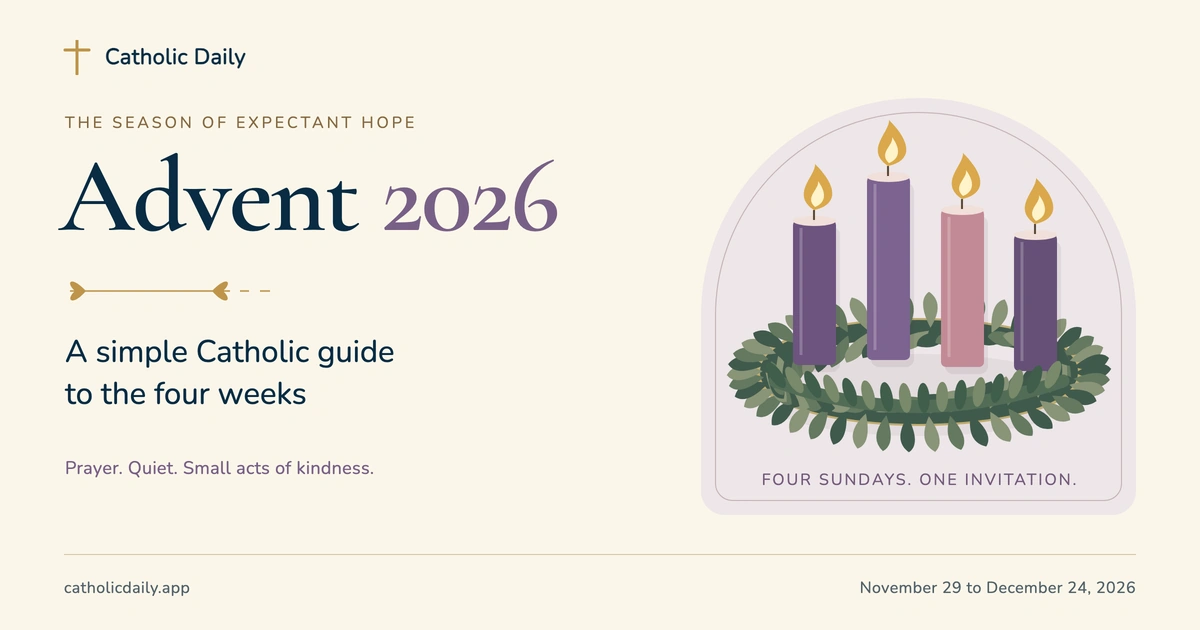
An Advent wreath traditionally has evergreen branches and four candles. USCCB's Advent guide describes three violet candles and one rose candle, while allowing white candles too. The growing light expresses expectation and hope.
Light one violet candle on November 29 and a second on December 6. Add the rose candle on December 13, then the remaining violet candle on December 20. On later days, light the candles already introduced that week.
Catholic Relief Services offers hope, faith, joy and peace as gifts to reflect on. Families and parishes may use different names or a different order. Those labels are a prayer aid, not a rule about which candle counts.
Choose a moment that fits your household, perhaps before dinner. You might pray: "Lord Jesus, help us make room for you today. Teach us to welcome you in the people who need our love." A brief, attentive prayer is enough to begin.
Gaudete Sunday: December 13, 2026
Gaudete means rejoice. On the Third Sunday of Advent, the rose candle marks a joyful pause as Christmas draws closer. This is a chance to notice the hope within preparation, even when the month feels busy.
Rose vestments may be worn in place of violet. They are not required, as GIRM 346 explains. If your priest wears violet, the Sunday remains Gaudete Sunday.
Is there a fast or obligation in Advent?
The Latin Church's universal law does not prescribe a separate Advent fast. It does prescribe fasting on Ash Wednesday and Good Friday, and identifies Fridays throughout the year as penitential days. How Friday penance is observed depends on the norms of your bishops' conference. See canons 1250-1253.
Sunday Mass remains an obligation during Advent, as it does throughout the year. Additional holy days vary by country, and legitimate reasons or dispensations can excuse attendance. Check your diocese rather than assuming another country's list applies to you.
You can voluntarily simplify a meal, give something away or reduce a distraction. Choose a practice that helps you pray and love others, rather than turning Advent into a test of endurance.
One small habit for each week
Week 1: Read the Sunday Gospel
Read Mark 13:33-37 slowly and choose one thought to carry into the day. Ask where you can become more attentive: at home, at work or when someone speaks. Keep the reading near a daily habit, such as your first cup of tea, so beginning again feels simple.
Week 2: Make space for confession
Look up your parish's confession times and choose a realistic opportunity. The Solemnity of the Immaculate Conception falls on December 8, a reminder of God's grace at work in Mary. If you have been away from confession, tell the priest and ask for help getting started.
Week 3: Choose a concrete act of charity
Let Gaudete Sunday's joy reach another person. Call someone who is alone, deliver food or support a local parish collection. From December 17 to 23, the Church prays the O Antiphons at Evening Prayer; their titles for Christ can guide a short daily prayer.
Week 4: Prepare the manger and your Christmas Mass plans
Set up or spend time beside your nativity scene, leaving a moment of quiet before the celebrations. Check your parish's Christmas schedule and discuss travel plans early. The USCCB's 2026 Advent calendar offers further daily suggestions if you would like a little structure.
Advent is not Christmas yet
The Church gives Advent its own pace. GIRM 305 and 313, summarized by USCCB, call for moderation in altar flowers and instrumental music during the liturgy, without anticipating Christmas's full joy.
At home, you might decorate gradually, enjoy Advent hymns or wait until Christmas Eve to place the child Jesus in the manger. These are invitations, not universal rules about family decorations or gatherings. Choose what helps your household remain attentive while welcoming the people around you.
Keep Advent on your phone
Catholic Daily offers the daily Gospel in the app and a liturgical calendar widget for your Home Screen, while a Sacred Moment reminder can help you set aside time for prayer. It is available in English, Spanish and Portuguese on iOS and Android. Download Catholic Daily from the App Store or Google Play, and follow our Home Screen widget guide if you need help getting started.
FAQ
When does Advent 2026 start?
Advent 2026 starts on Sunday, November 29, 2026, with the First Sunday of Advent. The season opens with First Evening Prayer on the evening before.
When does Advent end in 2026?
It ends on Thursday, December 24, 2026, before First Evening Prayer of Christmas. Christmas Day is Friday, December 25.
How many Sundays are in Advent 2026?
Four: November 29, December 6, December 13 and December 20.
What is Gaudete Sunday?
The Third Sunday of Advent, on December 13 in 2026. The word means Rejoice, and rose vestments may be worn instead of violet.
What colors are the Advent candles?
Traditionally, three candles are violet and one is rose, although white candles may also be used. The rose candle is lit on Gaudete Sunday.
Is Advent a time of fasting?
The Latin Church does not prescribe a separate universal Advent fast, though it is a season of prayer and preparation. Friday penance still applies according to local norms, so check your bishops' conference or diocese.